Tell us about the job
Takes about a minute. No obligation.
A compressor that starts up after months of sitting dry is where a contractor looks first on a Torrance County mini-split call. Homes in Torrance County, NM run cooling in a single month of the year, July. Refrigerant seals that rest that long can weep, capacitors drift, and contactor surfaces oxidize without the cycling that would otherwise keep them clean. The homeowner finds out on the first genuinely hot day, which is also when a contractor's schedule fills. Getting a unit inspected before July, rather than during it, puts the contractor in front of those faults before they strand the system mid-season.
A refrigerant leak or compressor fault in a house this old has usually been building for a while. Half the homes in Torrance County, New Mexico were built in 1987 or earlier (2020-2024 ACS 5-year). Stock from that era was put up around equipment that bears no resemblance to what a contractor opens today, and a mini-split that has been cycling through New Mexico summers in such a house carries that history in its coils and its refrigerant lines. When the unit comes apart, the condition of the compressor and the state of the refrigerant charge are where the repair scope is set, and both reflect how long the system has been working against the demands this climate puts on it.
The Parts of a Mini-split a Contractor Checks First
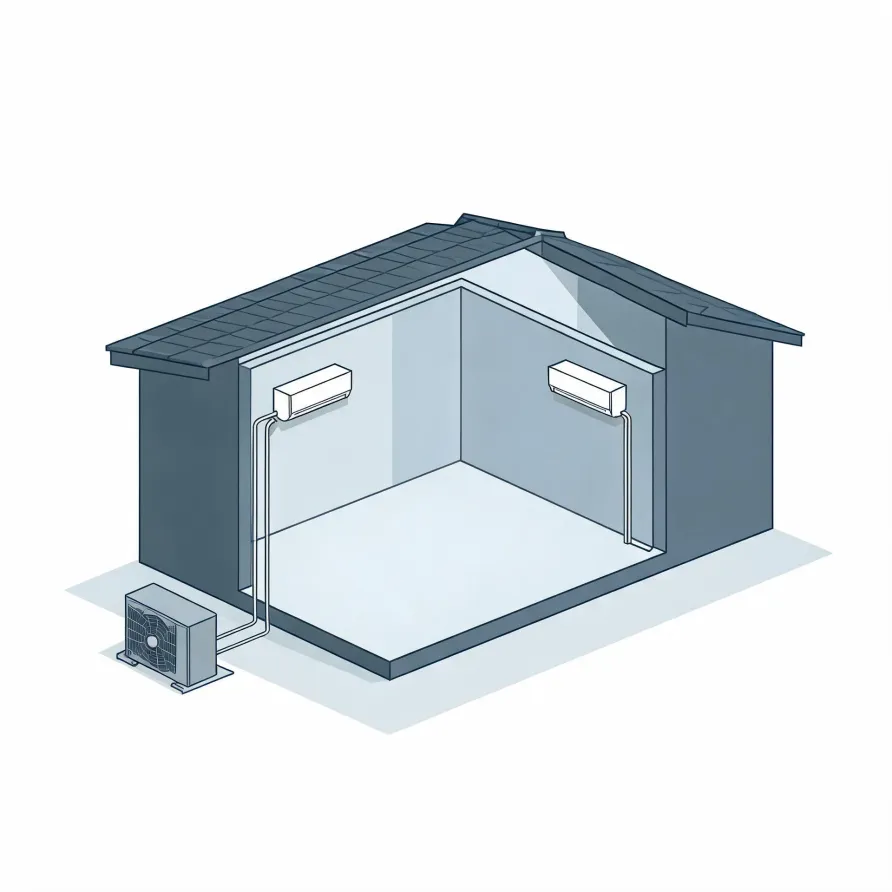
The indoor air handler mounts high on an interior wall and is the piece most homeowners notice first. It draws room air across a coil and a blower, and when it is the source of trouble, the symptoms show up as weak airflow, ice on the coil, or air that smells wrong. The outdoor condenser sits against the exterior wall and houses the compressor, which is the component contractors turn to when the system runs but produces no change in temperature.
A refrigerant line set runs through a small wall penetration to connect the two units, carrying the charge that makes the whole system work. A condensate drain line runs from the indoor unit to the outside, and a blocked drain is a common reason water shows up on a wall or ceiling. The control board inside the indoor unit is what a contractor checks when the unit fails to respond or throws an error code.
The drawing beside this text shows the general layout of a mini-split system, and a licensed contractor determines which components apply to your specific installation.
Get matched in Torrance CountyTorrance County by the Numbers
340 severe weather events were recorded in Torrance County, New Mexico between 2015 and 2024.
NOAA National Centers for Environmental Information, Storm Events Database, bulk CSV export, events 2015-01-01 through 2024-12-31.Half the homes in Torrance County, New Mexico were built in 1987 or earlier (2020-2024 ACS 5-year).
U.S. Census Bureau, 2020-2024 American Community Survey 5-Year EstimatesTorrance County, New Mexico holds 7,293 housing units (2020-2024 ACS 5-year).
U.S. Census Bureau, 2020-2024 American Community Survey 5-Year EstimatesOwners occupy 81.7% of the occupied homes in Torrance County, New Mexico (2020-2024 ACS 5-year).
U.S. Census Bureau, 2020-2024 American Community Survey 5-Year EstimatesRules & Standards Covering Mini-Split Repair in Torrance County, New Mexico2 sourced rules and standards
Licensing and Legal Requirements in Torrance County, New Mexico
New Mexico’s contractor licence does not reach casual, minor or inconsequential work taken one project at a time and totalling no more than seven thousand two hundred dollars ($7,200) a year — but the exemption has to be declared to the division, it is not automatic.
New Mexico requires a contractor licence classified for the work being done: no person may act as a contractor without one, and mechanical work falls to the division’s mechanical bureau.
Severe Weather Events in Torrance County
Extreme weather puts real stress on heating and cooling equipment, and that stress compounds over time. How hard a mini-split works, and how often it needs repair, is shaped by what the local climate asks of it.
340 severe weather events, 2015–2024. Source: NOAA National Centers for Environmental Information, Storm Events Database.