

Short defrost, normal operation
The outdoor fan stops, steam or hissing shows up for a few minutes, then heat comes back. No call needed. Your mini split is just clearing frost off the coil.
Defrost mode is your mini split pausing heat to melt ice off the outdoor unit. On winter nights in New Mexico, when the outdoor coil drops near freezing, moisture in the air turns to frost on it. Too much frost blocks airflow, so the system switches over, runs like an air conditioner for a few minutes to warm that coil, and you may notice the indoor fan slow down or stop and maybe some steam coming off the outdoor unit. That is normal and it should end on its own, usually within ten minutes or so. It becomes a problem when it keeps cycling back into defrost over and over, when the outdoor unit stays caked in ice well after, or when the indoor side stops putting out heat at all. Those point to something off with the system, not the cold night, and are worth having looked at before it struggles through the rest of winter.
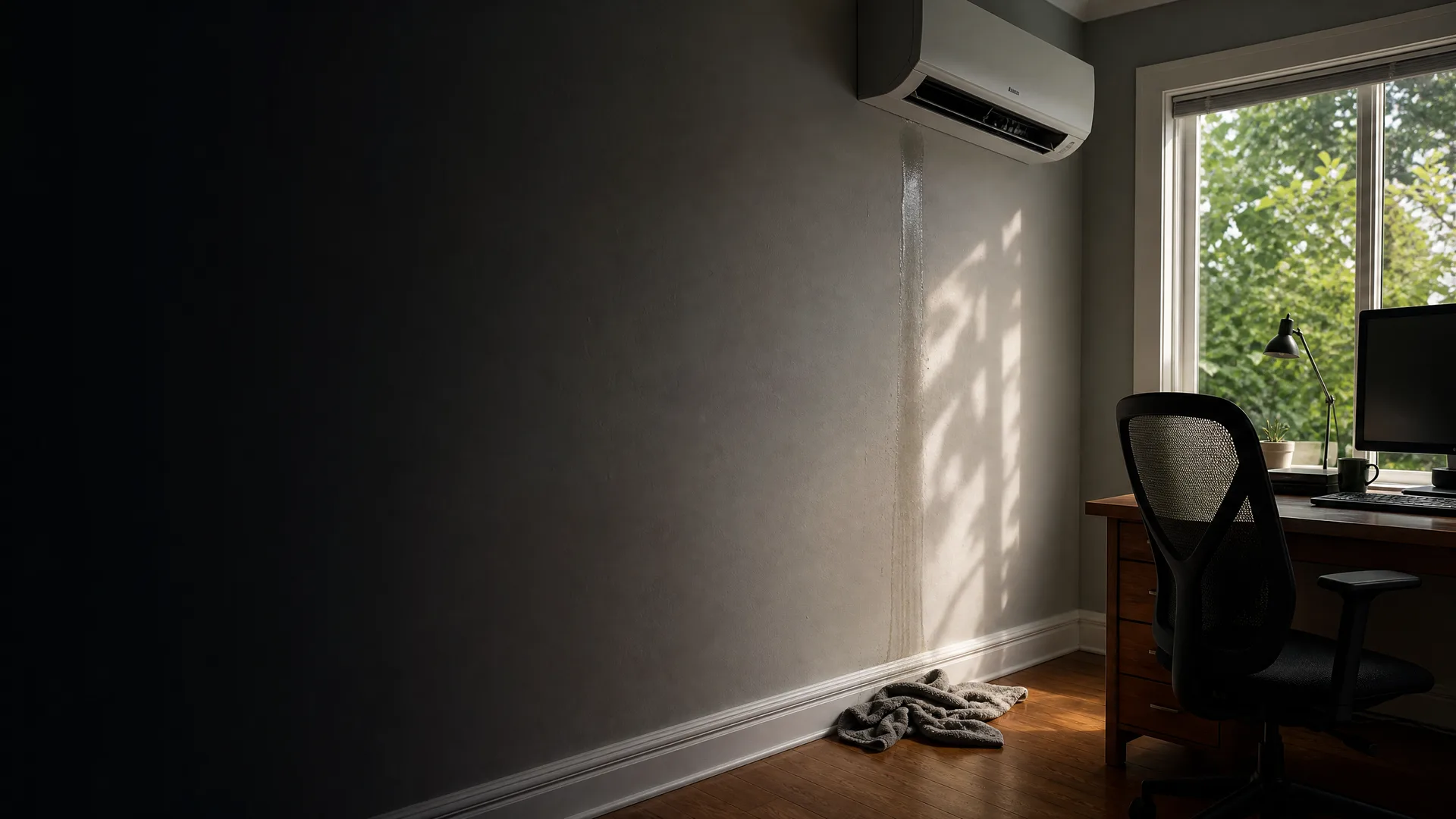
You're in the home office, working through the afternoon while the mini split blows cool air against the dry summer heat outside. Something drips. You look up and see a wet streak coming down the wall under the indoor unit, already pooling on the floor where you've thrown a towel down. The air out of the unit still feels fine, maybe even cold enough. But the water keeps coming, slow and steady, and the drywall under it is starting to darken. It isn't frost causing this, not in July. Something inside the unit isn't draining the way it should.
You turn the heat on and feel room temperature air, or air that's gone cold, coming out of the indoor unit. Outside, the fan has stopped and you might hear a faint hiss or see steam rising off the coil as it clears the frost. This is normal for a few minutes at a time. What isn't normal is the indoor unit blowing cold air for long stretches, or the outdoor unit staying iced over well after it should have cleared. If defrost cycles are running long or often, on a cold Albuquerque or Santa Fe night, the system isn't keeping up, and the house loses ground on heat while it struggles through it.
The outdoor coil senses it has dropped near freezing with frost building on it.
The system reverses the refrigerant cycle and stops sending heat indoors.
The outdoor fan shuts off while the hot refrigerant melts the frost off the coil.
The unit reverses back and resumes blowing warm air inside.

A normal defrost runs a few minutes and you barely notice. If your mini split is going into defrost over and over on a cold night, the room it heats will feel it. The vents blow cool or room temperature air each time the cycle kicks in, and on a night in the 20s that gap is enough to drop the room a few degrees before the unit switches back to heat. Since most homes here use gas for heat, this is likely a bedroom, sunroom, or converted space that leans on the mini split alone, so there's no furnace quietly picking up the slack.
A unit that won't come out of defrost, or cycles into it too often, is usually working around a problem rather than the weather. Frost that doesn't clear fully, a sensor reading wrong, or a fan that's slow to restart will all do it. Left alone, it's more electricity spent reversing the cycle for less heat delivered. If you send in what you're seeing, a contractor who works on mini splits in your area will get in touch and take a look at what's actually causing it.





A mini split that keeps cycling into defrost on a cold New Mexico night, or won't come out of it, isn't doing something wrong on its own. Frost is building faster than the system can clear it, or the reversing valve or a sensor isn't doing its job right. Either way, the room stays cold while gas furnaces elsewhere in the house carry the load, and that's not something to leave for the next cold snap. A contractor who works on mini splits can check the sensor readings, the refrigerant charge and the reversing valve, and tell you which one is behind the long cycles. Once you send the request, finding that person is off your plate. You don't have to figure out whether it's the coil, the valve or the control board before someone shows up. You just have to decide the cold room isn't something you want to keep living with.
A mini split in defrost mode can run that cycle for ten or fifteen minutes at a time before it switches back to heating.
That's the system working correctly. A unit that never defrosts on a cold, damp New Mexico night is the one with a problem, not the one that does.


The outdoor fan stops, steam or hissing shows up for a few minutes, then heat comes back. No call needed. Your mini split is just clearing frost off the coil.
Defrost runs long, repeats through the night, or heat never comes back after. That points to a sensor or reversing valve problem a contractor should check.


A mini split stuck in long or repeated defrost cycles is pulling backup heat strips or running the compressor harder to recover, and at 14.85 cents per kilowatt-hour that shows up on your bill fast. A quick repair keeps those extra cycles from adding up.
EIA-861 2025 statewide residential average


A mini split going into defrost on a cold New Mexico night is doing what it's built to do. Frost builds on the outdoor coil, the system pauses heat for a few minutes to melt it off, then goes back to warming the room. You might catch the outdoor fan stop, or see a little steam off the coil. That's the whole story, and it ends on its own.
What's worth noticing is when it doesn't end. If defrost runs long, comes back every few minutes, or heat never resumes after the fan stops, something in that cycle isn't working right. It could be the outdoor fan, the reversing valve, or a sensor reading the coil wrong. Any of those can leave a mini split stuck clearing frost that keeps coming back faster than it can melt it off.
That pattern doesn't fix itself by waiting. The system leans on backup heat strips or pushes the compressor harder to make up the difference, and that extra draw shows up on your power bill before long. You don't need to know which part is behind it. That's the part a contractor sorts out once they're looking at the unit, not something to diagnose standing in a cold room.
Send the form and a contractor who works on mini splits in your area gets the details and reaches out. From there, finding someone to look at it stops being on you.





Get the mini split repair search off your mind today.
You only hire the pro if you want to.