Send the form and stop researching installers for the new mini split.
A mini split that's too small will run flat out all July and still lose to the heat. One that's too big cools the room fast, shuts off, and leaves the air clammy instead of dry. In New Mexico, where summers are hot and dry and most homes heat with gas, getting the size right on the cooling side matters more than it does almost anywhere else.
Sizing a mini split isn't just the square footage of the room. It depends on your ceiling height, how many windows face the sun, what's on the other side of the walls, and what else in the house is already doing some of the work. A contractor who comes out and measures will land on a number specific to your house, not a rule of thumb off a chart.
That's the part that takes real legwork to get right, and it's also the part you don't have to do yourself. Finding a contractor who installs mini splits, checking they're licensed, calling a few for quotes, explaining your house and your situation each time, then sitting with the estimates to figure out who actually knows what they're doing: that's hours you don't get back, and most of it before anyone's even looked at your walls.
Send the form on this page and that search is done. You're not left with a list of names to call and vet on your own. The work of finding someone qualified to size and install your mini split moves off your plate the moment you hit submit.
What's left after that is the straightforward part: someone who installs these for a living comes out, looks at your specific house, and tells you the size that actually fits it. No more guessing from a chart, no more wondering if the number you found online applies to your walls, your sun, your ceiling.
Most New Mexico homes need less cooling capacity per square foot than the national charts assume. Those charts are built for humid climates, where a mini split has to wring moisture out of the air as well as cool it. Dry air gives up heat faster, so the same room here needs fewer BTUs to feel comfortable than it would in a humid state. Size it by that chart and you end up with a unit too big for the space, one that cools the room in minutes, shuts off, and leaves the air warm and clammy between cycles instead of steady. The right size comes from a load calculation that accounts for your square footage, your windows, your insulation, and your local climate data, not a rule of thumb. Since most homes here heat with gas, the mini split is doing cooling work alone, which is one more reason to get the sizing right the first time.
How sizing actually works
A mini split sizes to BTU per hour, and the indoor head is matched to the square footage and ceiling height of the one room it serves.
Manual J load calculations factor in window direction, insulation, and New Mexico's dry heat, not just square footage alone.
An undersized unit's compressor runs continuously at full speed, trying and failing to catch up on 100 degree afternoons.
An oversized unit short cycles, shutting off minutes after startup, which leaves the room cold on the surface but never properly dried out.
Adobe and thick-walled older homes often hold heat differently than new stucco builds, which changes the load even at the same square footage.
A contractor who sizes a multi-zone system also checks that the outdoor condenser can handle the combined demand of every indoor head running at once.
Sizing starts with a room by room load calculation, not a square footage chart taped to a wall. A contractor measures the room, checks which way the windows face, notes how much insulation is behind the walls, and runs that through a Manual J calculation. The output is a number in BTU per hour, and that number tells you which indoor head goes in that room. Skip this step and you get a guess instead of a fit.
Dry heat changes the math. A mini split sized for a humid state will often be too big for the same square footage here, because it was built to pull moisture out of the air on top of cooling it. New Mexico air doesn't carry that load, so the unit doesn't need to work as hard to feel comfortable.
The walls matter too. An adobe home or an older home with thick walls holds and releases heat on a different schedule than a new stucco build, even if both are the same size. That changes the load calculation, not just the finish work.
For a multi-zone system, the sizing doesn't stop at the indoor heads. The outdoor condenser has to be checked against every zone running at once, on the hottest afternoon of the year, not just one room at a time. A contractor who skips that check can leave you with a system that handles two zones fine and falls apart on the third.
A mini split sized right for the room keeps a steady, even cool without straining, which is what dry New Mexico heat actually asks of it.
A unit choked with dust on the coil and vents loses its grip on the room, and the wrong size only makes that strain worse, faster.
1
A contractor measures the room's square footage and ceiling height.
2
They check window direction, shading, and how much insulation the walls hold.
3
They run a Manual J load calculation for New Mexico's dry heat.
4
They match the BTU output to an indoor head sized for that room.
Why does your mini split run all afternoon and still feel warm
If the room never quite catches up by late afternoon, and the unit is still blowing when you sit down for dinner, it's working harder than it should for the square footage it's in. Some rooms short-cycle instead: cool fast, shut off, and within twenty minutes the heat's back because the unit never ran long enough to pull the air dry. You might notice the wall near the indoor head stays warm to the touch, or the breaker trips on the hottest days. A unit that's undersized for its room runs that way every day from May through September, and a unit that's oversized wears out its compressor faster by starting and stopping more than it should.
Sized right for the room
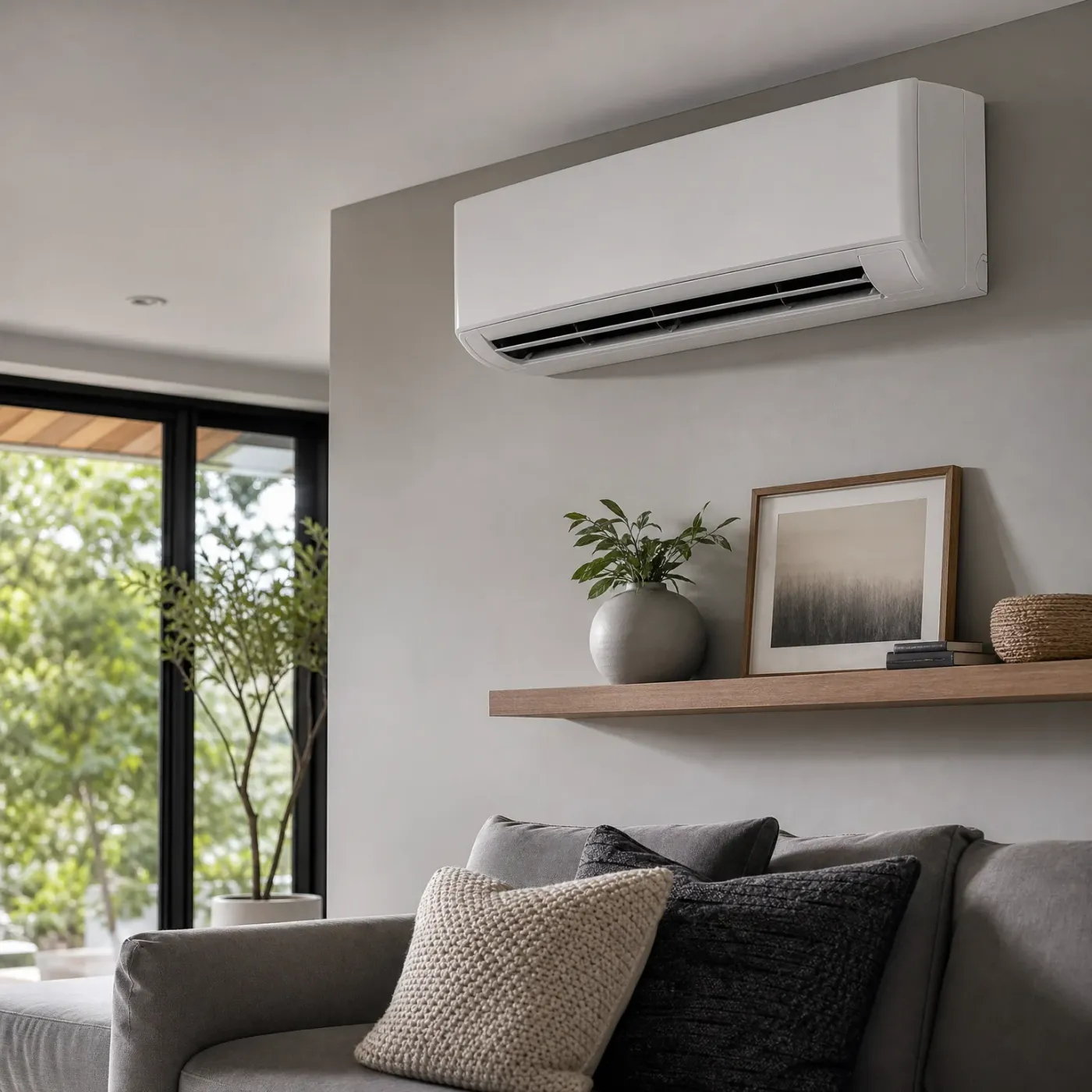
This is what a correctly sized mini split looks like doing its job. It holds the room at a steady temperature without cycling on and off every few minutes, and the air coming off it stays dry the way New Mexico air should feel, even in July.
Choked and undersized
Dust like this builds up when a unit runs nonstop trying to keep up with a room it was never sized for. The coil behind that yellowed casing is working overtime, and a struggling mini split pulls in more dust and grime the harder it runs.
Before you get your mini split installationAfter you get your mini split installation
Let someone else find the pro
Skip the round of in-home estimates for a new mini split.
One request ends the search for a mini split installer.
No charge to send it. You decide if you hire them.
A mini split loses capacity in direct sun, and a west-facing room in New Mexico can carry heat load through an uninsulated wall well past the point an east room has cooled off.
That's why two rooms the same size in the same house can need different BTU ratings, and why a contractor sizes the unit to the room, not the floor plan.
Power costs 14.85 cents per kilowatt-hour statewide
At 14.85 cents a kilowatt-hour, running an oversized mini split all afternoon costs you more for air that never quite dries out right. Getting the BTU size matched to the room means it reaches temperature and holds there, instead of drawing power on a unit that's fighting itself.
EIA-861 2025 statewide residential average
Running the way it should
This is a mini split sized and installed right. The panel stays clean, the room holds its temperature, and there's nothing straining to keep up with New Mexico's afternoon heat. It just runs.
Worn down and undersized
Dust and discoloration like this build up on a unit that's been working too hard for too long, often because it was never matched to the room. Sorting out who can come look at it, explain what's wrong, and quote the fix is its own chore. Send the form and that search is off your plate.
How many BTUs do I need for a 12x12 room?
A 12x12 room is 144 square feet, and it's the number most people start with when they're trying to size a mini split themselves before calling anyone. The trouble is that a square footage chart alone doesn't account for which way the room faces or what's on the other side of the walls, and in New Mexico's dry heat the standard numbers run a little high anyway.
A 12x12 room usually needs around 5,000 to 6,000 BTU, less if it's shaded
That range covers most 144-square-foot rooms with normal ceiling height and no unusual heat load. But a west-facing room with a lot of afternoon sun through the window can push toward the top of that range or past it, while a shaded north room with good insulation might run fine on less. New Mexico's dry air also means a mini split doesn't need the extra capacity that humid-climate charts build in for pulling moisture out of the air. The only way to know the actual number for your room is a Manual J load calculation, which weighs ceiling height, window direction, and wall insulation against square footage instead of relying on it alone.
The dew point across New Mexico averages 45°F in June, July and August, a figure from NOAA climate data. That's dry air, the kind that gives up heat fast once a mini split gets going. It also means the unit isn't fighting moisture the way one would in a humid state. A properly sized mini split pulls the heat down and the room feels dry and comfortable within a reasonable stretch of running. An oversized one shuts off before it's done that work, and even in air this dry, you'll notice the room cool fast but still feel a little clammy underfoot.
NASA POWER T2MDEW county cells weighted by homes
The right size comes down to the room, not a chart
A mini split sized to the actual room, its windows, its walls, its sun, holds New Mexico's dry heat at bay without straining. One sized off a square footage chart alone either runs flat out all afternoon or short-cycles and leaves the air clammy. The difference shows up every July afternoon you're home to feel it.
Getting there means someone has to measure the room, check the walls and windows, and run the load calculation for your house specifically. You could spend evenings calling around, asking each contractor the same questions, and comparing bids that may not even be sizing the unit the same way. Send the form instead and that search is done. You won't need to track down who's reliable or repeat the details of your room to three different companies. Someone qualified gets the particulars and takes it from there.
One request and it's handed off
Describe the project once instead of to every installer.