


Profile view of a bearded man wearing a dark baseball cap and a dark gray T-shirt against a plain off-white background.

Why your mini split blows cold air in New Mexico

Step 1 of 3: Equipment

Why is my mini split blowing cold air when it's set to heat?

You switched your mini split over to heat and cold air is still coming out of the vents. In a New Mexico winter, with gas heat probably running the rest of the house, that's confusing, especially if you're used to catching small problems before they turn into bigger ones. You want to know whether this is something to watch for a few minutes or something to call about now.

It's likely stuck in defrost or set to the wrong mode

A mini split blowing cold air on heat mode usually means one of two things. It could be running a defrost cycle, where the outdoor unit clears frost off its coil and the indoor unit blows cool air for a few minutes until it switches back. Or the remote or thermostat is set to fan or cool instead of heat, which is easy to do by mistake. If the air stays cold for more than ten or fifteen minutes, the system isn't recovering on its own. That points to a problem with the reversing valve, the one part that switches the unit between heating and cooling, or a refrigerant charge that's too low to produce warm air at all.

A woman in a cream cowl-neck sweater stands in a lamp-lit room looking out a window at a snow-covered yard with shrubs and bare trees at dusk.
A woman in a gray turtleneck sweater stands near a large window in a lamp-lit living room, looking out at falling snow and snow-covered conifers.
A woman in a chunky knit sweater stands by a large window looking out at snow-covered ground, with a dimly lit living room containing a gray sofa, framed artwork, shelves and table lamps behind her.
A woman in a gray turtleneck sweater stands in a dimly lit living room with a lamp and bookshelves, looking out a multi-pane window at falling snow.
A white wall-mounted mini-split air conditioner near the ceiling of a room with light gray walls, white crown molding, and a beige curtain at the left edge.
A clean mini split runs through its heat cycle and warms the room within a few minutes, no cold air lingering.
A dusty beige wall-mounted mini-split air conditioner indoor unit installed high on a plain light-colored wall below the ceiling.
Dust packed in the coil and grime on the wall above it block warm air and point to a system overdue for a look.
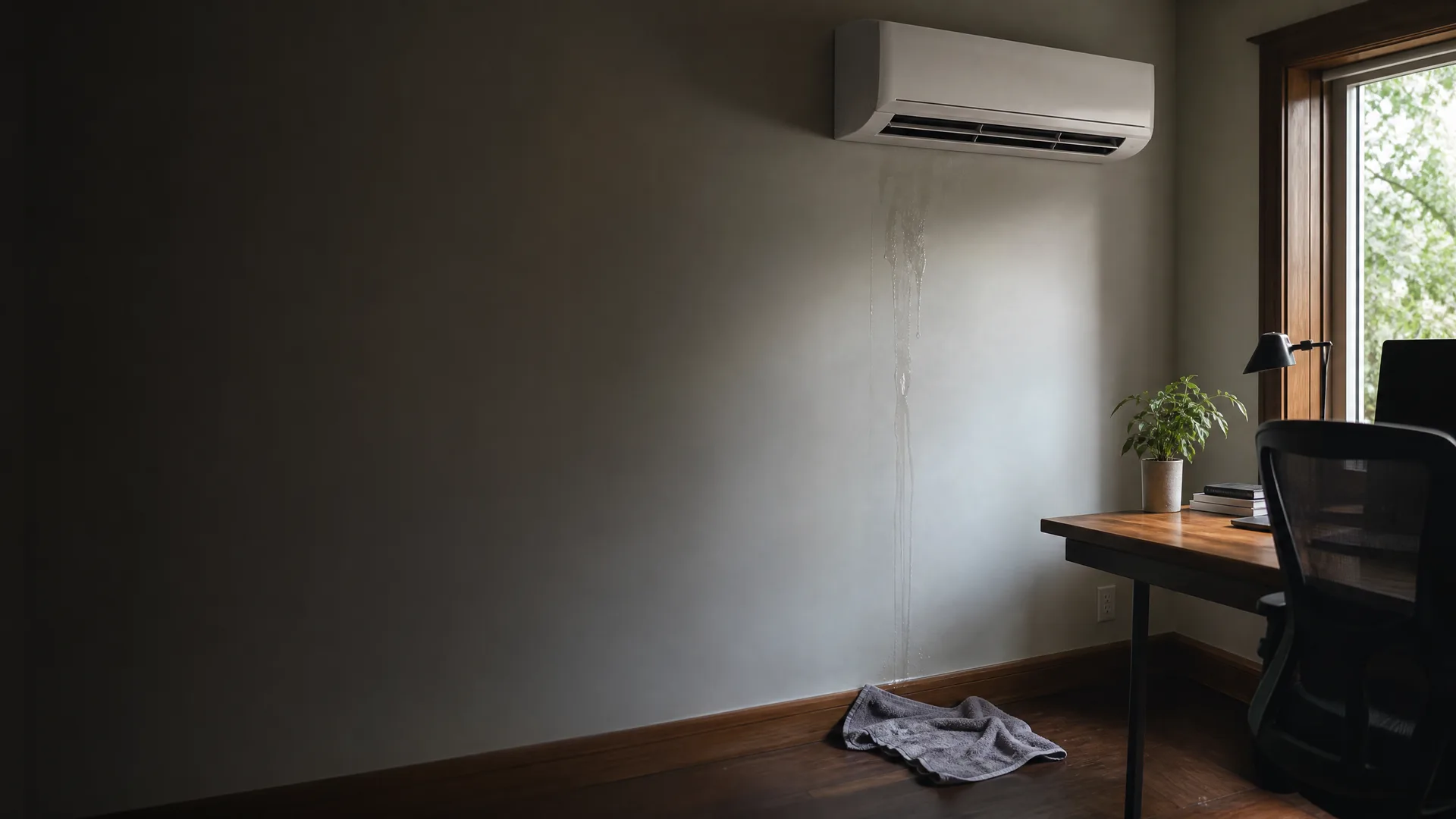
A wall-mounted mini-split air conditioner with a water streak running down the wall beneath it to a gray towel on the wood floor, beside a desk with a potted plant, lamp, and office chair near a window.

You're working at your desk on a hot afternoon, and you notice the wall under the mini split looks dark and wet. A thin streak runs down from the unit toward the baseboard. You grab a towel off the bathroom rack and lay it on the floor under the drip line, then go back to your desk for a minute before you look again. The streak hasn't grown, but it hasn't dried either. Outside the New Mexico sun is doing its usual work, the room is cool enough, and the unit sounds the same as always. The towel is already damp at one corner.

A woman stands in the open doorway of a white stucco house holding the dark door, facing a man in a black cap and shirt seen from behind in the blurred foreground, with a potted flowering plant beside the entry.

What happens inside the unit when you switch it to heat

A mini split doesn't make heat the way a gas furnace does. It pulls heat out of the outside air and moves it inside through the refrigerant line, then the indoor unit blows air across the coil to carry that heat into the room. Right after you switch from cooling to heat, the system has to reverse the flow of refrigerant through a part called the reversing valve. Until that valve shifts and the coil warms up, the air coming off the indoor unit is still cold, because it was cold a minute ago and the fan hasn't caught up yet.

That delay should last a couple of minutes at most. If your unit keeps blowing cold well past that, the reversing valve may not be shifting all the way, or the outdoor unit may be struggling to pull heat from the air at all. Either one is a job for someone who can get a gauge on the line and watch what the valve is actually doing. A local contractor who works on mini splits can look at yours and tell you which part is at fault.

Interior corner of a dining room with a round wooden table, a ceramic vase holding olive branches, a dark spindle-back chair near a curtained window, and a sideboard with a lamp against beige walls.
A white wall-mounted mini-split air conditioner on a beige interior wall, with a curtained window on the left and wood flooring with a light rug below.

Working normally

Switch this one to heat and air coming off the wall unit warms up fast. Stand near it and you feel the change within a couple of minutes. No cold air hangs around once the indoor coil picks up heat from outside and the fan starts moving it into the room.


A white wall-mounted mini-split air conditioner indoor unit installed near the ceiling on a plain light-colored wall, with its horizontal outlet vent and louvers visible.

Signs of trouble

Dust sits heavy on the casing and the vents have gone gray. A unit that looks like this has likely gone a long stretch without a cleaning. That buildup sits between the coil and the room, and it's often why heat mode still feels like cold air blowing on you.

A bearded man in a plaid flannel shirt stands indoors looking out a frost-covered window, with a steaming dark blue mug on the wooden sill and snow-covered trees outside.
A smiling man in a dark blue T-shirt sits on a light gray sofa in a living room with a wooden shelf and window behind him, with a laptop edge visible in the foreground.

Matched to your mini split job

Send the request today and let a mini split pro reach out to you.

You're not committing to anything by asking.

The defrost cycle is normal, briefly

On a cold morning, frost builds up on the outdoor unit's coil, same as it would on any heat pump working outside in winter. The system has to clear that off to keep pulling heat from the air. To do it, the mini split reverses itself for a few minutes, runs like an air conditioner to melt the frost, and the indoor fan blows cool air while that happens. That's a normal part of running a heat pump through a New Mexico winter, and it should pass in well under ten minutes. If the indoor unit is blowing cold well past that, or every time the outdoor temperature drops, the system isn't finishing its cycle the way it should.

What a longer cold spell points to

A refrigerant leak slows everything down. With less refrigerant in the line, the system takes longer to reverse out of defrost and longer to build any real heat once it does, so you feel cold air stretch from a few minutes into ten or fifteen. A failing reversing valve can get stuck partway, holding the system in cooling mode even after the coil has cleared. Either one means the mini split is working harder for less heat, which shows up on the power bill before it shows up as a breakdown. A contractor can check the refrigerant charge and test the valve to find which one it is.

Power costs 14.85 cents per kilowatt-hour statewide

At 14.85 cents per kilowatt-hour, every extra minute your mini split blows cold air before it catches up to heat is a minute of power spent for nothing. Catching the problem early, instead of letting it run that way all winter, keeps that cost from adding up on your bill.

EIA-861 2025 statewide residential average

What Your Mini Split Is Telling You

  • Cold air at startup on heat mode is normal and clears within a few minutes once the indoor coil warms up.
  • Cold air that lingers past that points to low refrigerant, a stuck reversing valve, or a dirty coil blocking warm airflow.
  • A defrost cycle on a cold morning can send a short burst of cooler air before the system switches back to heating.
  • Dust on the coil or grime on the wall below the unit is a sign the system is overdue for a look.
  • A mini split pulls heat from outside air rather than generating it, so outdoor temperature and coil condition both affect how fast it warms a room.
  • Letting the problem run through a New Mexico winter costs power for every extra minute the unit blows cold before it catches up.

A few minutes of cold air when you first switch to heat is just the indoor coil catching up. That's normal. What isn't normal is cold air that keeps coming, or comes back again and again through the day. That's the system telling you something is wrong with how it moves heat, whether that's refrigerant running low, a reversing valve that isn't fully switching over, or a coil so coated in dust it can't pass warm air through to the room. A short cool burst on a cold morning, while the outdoor unit clears frost off its coil, is the system doing its job. A streak of grime on the wall below the unit, or a drip line that shouldn't be there, is the system falling behind on its job.

None of this fixes itself. A mini split that's lagging on heat now will lag more as outdoor temperatures drop further into winter, because it's already pulling less heat than it should from air that's about to get colder. The power meter keeps running the whole time the unit blows cold air it can't turn into heat.

You don't have to figure out which of these it is. That's diagnostic work for someone who does it for a living, with the right gauges and a look at the actual unit. Send the form and a contractor who handles mini splits in your area will reach out. From there, finding the cause stops being something you have to carry.

A sunlit room corner with cream walls, white baseboard and window sill molding, a wood floor, and a dark wooden cabinet on the right holding a pale vase with leafy branches below a framed picture.
A round woven basket with a cream fringed throw draped over its rim sits in a corner on a wood floor, beside a dark wooden cabinet holding a stone vessel, with sunlight from a nearby window on the beige walls.
Interior corner of a room with a white-trimmed window and sill, beige walls, white baseboard molding, and a wood floor with sunlight falling across it; green foliage is blurred outside the window.
Interior corner of a room with cream walls, white baseboard molding, a window with a white sill showing blurred green foliage outside, and a wood plank floor lit by sunlight.
Sunlit interior corner showing a beige wall with a small crack above white baseboard molding, wood plank flooring, a patterned rug edge at lower left, and a window with sill at upper left.

A mini split pro near you

Get the mini split repair search off your mind today.

Send my request

It costs nothing to send, and you don't have to hire anyone.